
Every e-commerce team I've worked with has the same document somewhere. A list of features that would obviously help the business, ordered roughly by how much someone believes in them, with maybe two of them scheduled for this quarter.
The list isn't short because anyone lacks ideas. It's short because of arithmetic. A feature takes a certain number of engineering days, days cost money, and so most of the list waits.
What's changed over the past two years is that second number. Not by a little.
What "Agentic" Actually Means Here
Plenty of teams have already tried AI code completion, the kind that suggests the next line while you type. It's genuinely useful for typing speed. It doesn't change your budget, because typing was never the expensive part.
Claude Code works differently. It's an agentic tool, which in practice means it has access to your whole codebase and it acts rather than suggests. Describe a bug, and it traces the cause through your code and implements a fix. Describe a feature, and it plans an approach, edits across however many files that takes, runs your test suite, fixes what breaks, and hands back a branch for review.
You can run it from the terminal, from a native VS Code extension or JetBrains plugin, from a desktop app, or in the browser. It also runs headlessly in CI using print mode (claude -p), which matters more than it sounds like it should — we'll come back to that.
A Worked Example: Fifteen Days Becomes Two
Productivity percentages don't help anyone approve a budget, so here's something specific and fairly ordinary: a "Frequently Bought Together" bundle module on the product page, with automatic bundle pricing, stock-aware logic, and one-click add-to-cart.
Nothing clever. Most stores want it. Plenty don't have it, for reasons that will be familiar.
The traditional build — call it 15 working days
- Days 1–2 · Discovery. Someone reads the existing catalog, cart and pricing code to work out how variants, tax and discounts currently interact.
- Days 3–4 · Specification. Technical spec, data model decisions, design handoff, estimation.
- Days 5–9 · Backend. The recommendation query, a new endpoint, bundle pricing rules, and how all of that behaves alongside existing promotions.
- Days 10–12 · Frontend. Component, responsive states, loading and error handling, cart integration.
- Day 13 · Tests. Usually the first thing cut when the estimate slips.
- Day 14 · QA and bug fixes. Out-of-stock variants, multi-currency, tax-inclusive pricing.
- Day 15 · Deploy. Monitor and document.
Two or three people involved across three calendar weeks. At most agency or in-house blended rates that's a five-figure feature, which is exactly why it's still on the list.
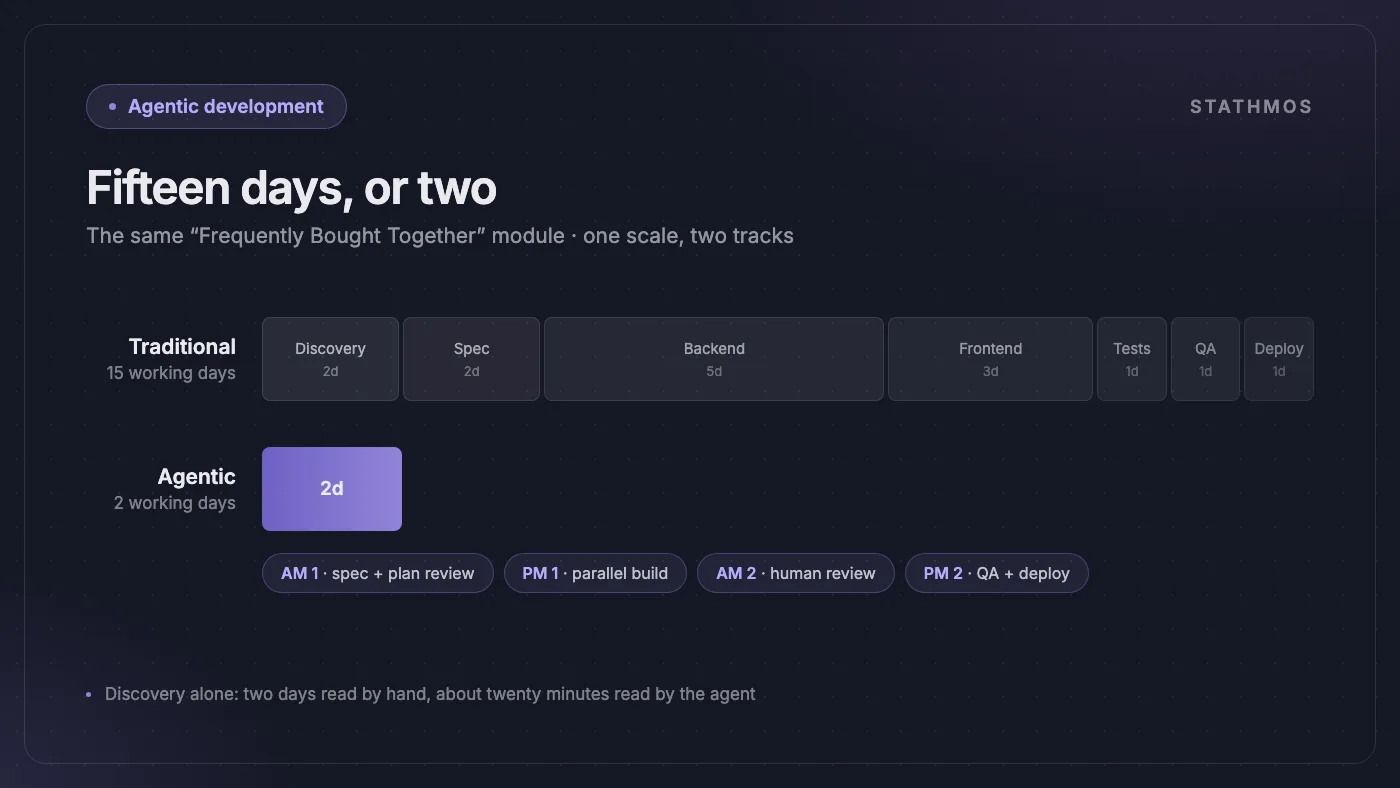
The same thing with an agent — roughly 2 days
Day one, morning. Somebody writes a proper specification: the business rules, the pricing behaviour, the edge cases that actually matter. Claude Code reads the codebase and comes back with a plan — which files it intends to touch, how it will hook into the existing cart logic, where it thinks the risk is. You correct the plan before any code gets written. This ninety minutes is the highest-leverage part of the whole project, and it's entirely human judgement.
Day one, afternoon. Work runs in parallel. Claude Code has several built-in ways to do this: subagents that handle a scoped task and report back, agent view for dispatching background sessions, dynamic workflows for larger jobs, and worktrees that give each session its own git checkout so parallel work doesn't collide on the same files. There's also an experimental agent teams mode with a shared task list, though it's disabled by default and worth treating as early-stage.
So one workstream on the endpoint and pricing logic, one on the frontend component, one on tests. Discovery, which took two days by hand, took about twenty minutes, because the agent read the codebase rather than learning it.
Day two, morning. Review. This is where your senior engineer's time goes now: checking pricing logic against real promotion rules, confirming what happens when a bundle item sells out mid-session, verifying tax treatment. Corrections go back and return in minutes.
Day two, afternoon. QA, staging, deploy. Tests and documentation already exist, because producing them cost almost nothing.
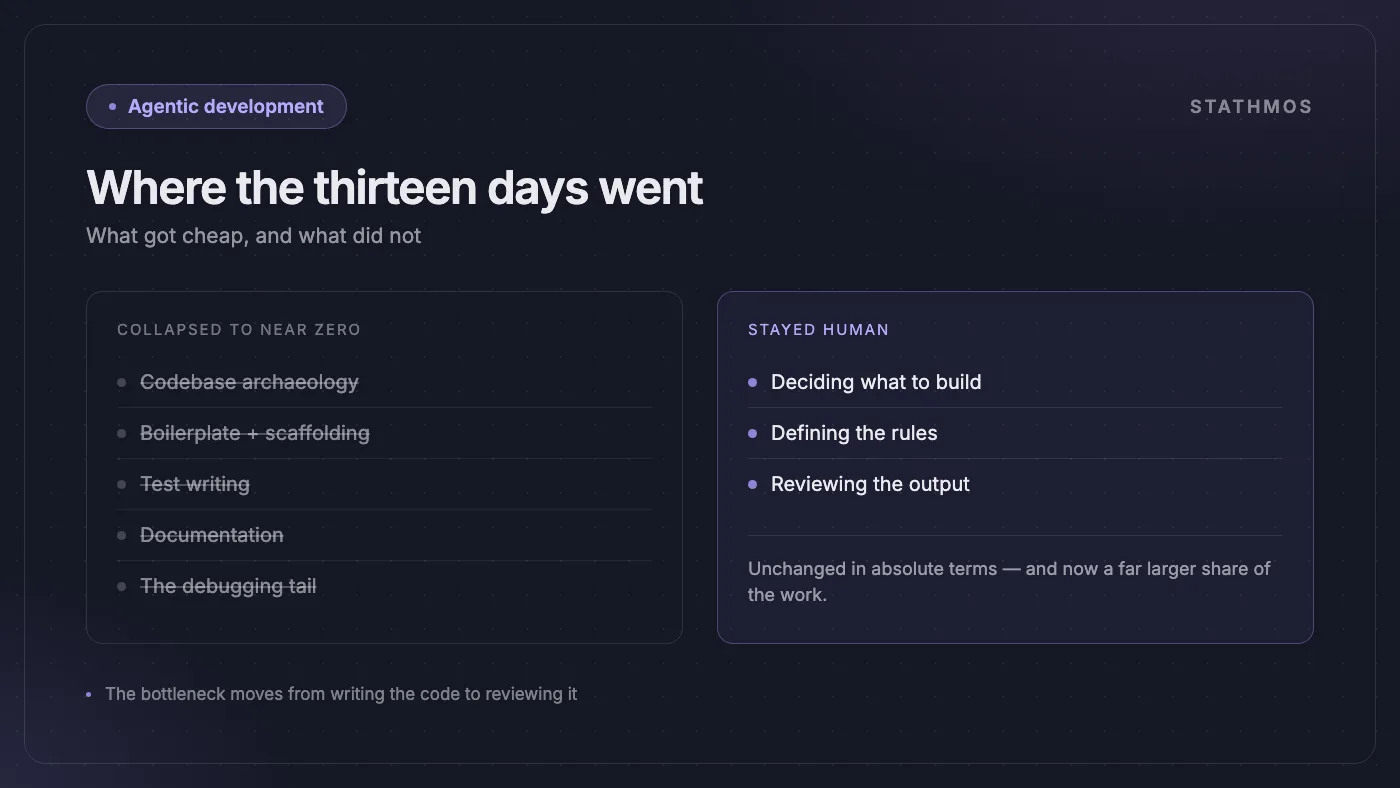
Where the thirteen days went
Worth looking at, because it explains the whole shift:
- Codebase archaeology. An agent reads code far faster than a person learns it.
- Boilerplate — endpoints, scaffolding, state handling, error states.
- Test writing, now cheap enough that it stops being negotiable.
- Documentation, which becomes a by-product rather than a task.
- The debugging tail, since the agent runs the tests and fixes its own failures before anyone else sees the branch.
And what didn't compress: deciding what to build, defining the rules, and reviewing the output. Those stayed human. They also became a much larger share of the work.
This isn't just a thought experiment
Rakuten — which runs over 70 businesses across e-commerce, travel, fintech and communications — published their numbers with Anthropic.
- Time to market
- 24 days → 5
- Reduction
- 79%
- Autonomous coding
- 7 hours sustained
- Code accuracy
- 99.9%
The seven-hour figure came from a complex open-source refactoring project run end to end, with 99.9% accuracy on the resulting code modifications. So the shape of the 15-to-2 example above is already happening at considerable scale.
Other published results are more modest, which is worth knowing. The development agency Boldare reported sprint velocity up as much as 31% in a single quarter, with AI touching an estimated 75–85% of new code and tests. HubSpot reported complex technical troubleshooting falling from three to five days down to under an hour, and used Claude Code to speed up a frontend migration during a rebrand that would otherwise have taken months. HubSpot notes those figures come from internal analysis of selected implementations and are illustrative.
A realistic planning assumption: somewhere between 3x and 7x on well-specified, self-contained features, and considerably less on the messy organisational parts of delivery. A payment integration with a compliance review isn't collapsing to two days. A UI improvement might beat 10x. Plan for the average, not the best case.
The Volume Is the Point, Not the Saving
Here's the part that tends to get missed in cost conversations.
Take one developer working on features of roughly that size. At fifteen days each they'll ship something like sixteen a year. At a blended three days each — some faster, some slower — that number lands nearer eighty.
| Metric | Traditional | Agenticblended |
|---|---|---|
| Days per feature | 15 | 3 |
| Features per year | ~16 | ~80 |
Read those as a ratio rather than a capacity forecast. No developer spends 240 days a year purely on new features — there's maintenance, incidents, meetings, holiday. Both rows are inflated by the same assumption, so the relationship between them holds even though neither number would survive contact with a real sprint board. And eighty features a year is more than most teams could review properly, which is a constraint I'll come back to.
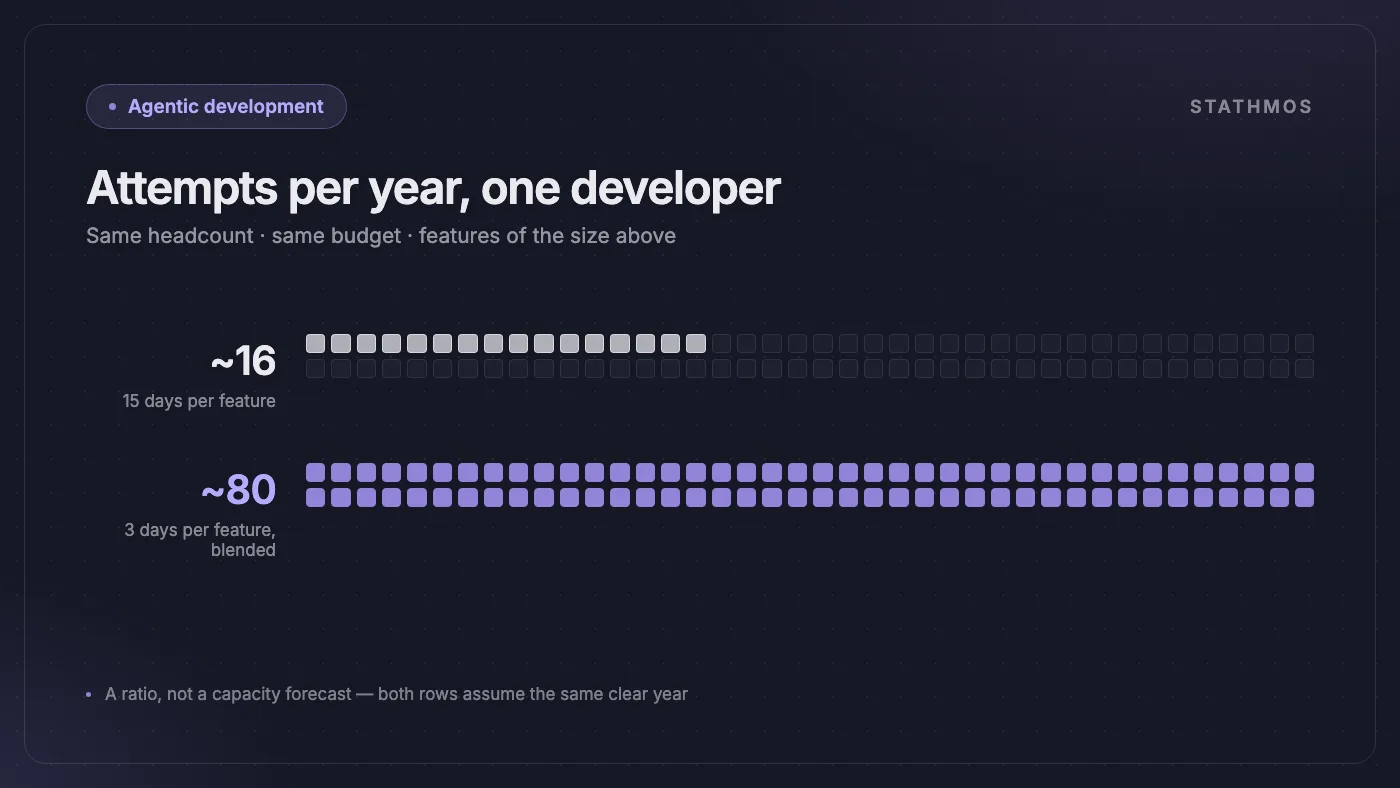
Nobody's headcount changed. The budget didn't change. What changed is the number of attempts you get.
That matters because conversion optimisation is fundamentally a search problem. Nobody knows in advance which change moves the number. You find out by shipping and measuring, and the team that can afford more attempts finds the better answer sooner.
Think about what a store can suddenly justify building:
- Back-in-stock alerts on every out-of-stock variant
- A bundle builder, or a "complete the look" module
- Self-service returns and exchanges, taking tickets out of the support queue
- Size guides with real fit data, which tends to pull return rates down
- Structured data across the full catalogue for richer search listings
- A wishlist that emails on price drops
- Page-speed work on the templates that need it most
- Guest checkout improvements and properly segmented abandoned-cart recovery
- Internal pricing tools, so merchandisers stop filing tickets for rule changes
Individually these are small levers, each worth a fraction of a percent. Together over a year they compound — and compounding is exactly what the old cost structure prevented. At fifteen days apiece that list is a multi-year roadmap. At three, it's a couple of quarters.
Worth sitting with: a competitor running four experiments a quarter against your twelve isn't three times slower. They're learning three times slower, and that gap doesn't close by hiring.
Three Things Beyond Raw Speed
Architectural context stops leaving with people
When an experienced engineer moves on, the expensive loss is usually context rather than code — why things were built the way they were. Claude Code helps here through a CLAUDE.md file in your project root, holding architectural decisions, preferred libraries, conventions, and security standards. Every session reads it, so generated code follows your house rules rather than generic patterns.
It's a reasonable way to make senior judgement persistent. It also shortens onboarding considerably, since a new joiner can ask the codebase questions directly instead of spending weeks reconstructing intent.
It handles server-side complexity, not just interfaces
Fair scepticism from most CTOs: fine for rendering components, but what about the parts that keep me awake? In practice the agent is at its most useful in exactly those places, because that's where reading unfamiliar code costs the most. Mapping multi-region order routing rules. Scaffolding a background queue to survive a bulk catalogue import. Tracing why a promotion stacks incorrectly across three services. These are context problems more than typing problems.
Work that runs without anybody attached
Because it runs headlessly with claude -p, you can put it in GitHub Actions or any CI pipeline and wire it to the events you already emit — fire it when a pull request opens so every PR gets a first-pass review before a human looks at it, or when a build goes red so the failure has been triaged by the time someone reads the alert. Beyond that: weekly dependency and security audits, documentation sync after merges. Scheduled routines run in the cloud regardless of whether anyone's laptop is on.
This is a whole category of work that previously needed either a dedicated person or, realistically, nobody at all.
What to Plan For Honestly
Three things will decide whether you get the results above or a disappointing pilot.
Review becomes the constraint. Generation got cheap; review didn't. A pattern that shows up repeatedly is a sharp productivity jump in the first weeks, followed by a decline once code starts shipping faster than the team can properly review it, which forces rework on the same features. If you multiply output without touching your review process, you've moved the bottleneck rather than removed it. Strengthen CI gates and automated first-pass review before volume climbs, not after — we've written up the code-review policy we actually run for agent-written changes, and the security idioms worth grepping for in generated PHP.
Casual adoption fades. Teams that define how they work — a maintained CLAUDE.md, planning before coding, clear rules about what an agent may touch unsupervised — hold onto the gains. Teams that leave it to whoever's enthusiastic see a spike and then a slow drift back. It's a process change more than a tool purchase.
Specification quality becomes the ceiling. That two-day build only works because someone wrote a good spec. Vague instructions produce confidently wrong output, quickly. The scarce skill is shifting from writing the code to knowing precisely what should exist, which is worth thinking about in how you hire and who you develop.
One practical note: running several sessions or subagents simultaneously multiplies token usage. Set spend limits and give someone ownership of watching them. If you want the full picture on what applied AI actually costs to run, we broke it down in e-commerce AI implementation costs.
Where This Leaves You
The useful way to frame this internally isn't "we can spend less on the same roadmap." It's that a roadmap you'd previously have called unrealistic is now worth costing properly.
Both readings are defensible. The second one is the one that tends to show up in revenue.
Frequently asked questions
How is Claude Code different from AI code completion?
Completion suggests the next line while you type, which speeds up typing but not delivery. Claude Code is agentic: it has access to the whole codebase and acts rather than suggests — it plans an approach, edits across as many files as the change needs, runs your test suite, fixes what breaks, and hands back a branch for review.
How much faster is agentic development, realistically?
Plan for 3x to 7x on well-specified, self-contained features, and considerably less on work with heavy organisational overhead such as a payment integration requiring compliance review. Rakuten published a drop from 24 working days to 5 (79%); Boldare reported sprint velocity up as much as 31% in a quarter. Plan for the average, not the best case.
What is the new bottleneck once code generation gets cheap?
Review. Generation got cheap and review did not. The common pattern is a sharp productivity jump followed by a decline once code ships faster than the team can properly review it, which forces rework. Strengthen CI gates and automated first-pass review before volume climbs, not after.
Does an agent handle backend complexity or only frontend work?
Backend work is often where it helps most, because that is where reading unfamiliar code costs the most — mapping multi-region order routing, scaffolding a background queue to survive a bulk catalogue import, or tracing a promotion that stacks incorrectly across three services. These are context problems more than typing problems.
What does a CLAUDE.md file do?
It is a file in your project root holding architectural decisions, preferred libraries, conventions and security standards. Every session reads it, so generated code follows your house rules rather than generic patterns. It also makes senior judgement persistent when an experienced engineer leaves, and shortens onboarding for new joiners.
Can Claude Code run without a developer sitting there?
Yes — print mode (claude -p) runs it headlessly, so it fits GitHub Actions or any CI pipeline. Common uses are a first-pass review when a pull request opens, triage when a build goes red, weekly dependency and security audits, and documentation sync after merges. Scheduled routines run in the cloud regardless of whether anyone's laptop is on.
Product capabilities and case study figures were verified in August 2026. Results vary by codebase, team and configuration; the 15-to-2 day example is illustrative and built from the component tasks described, not a measurement of a single client project.
Sources
Costing a Roadmap You Previously Called Unrealistic?
This is how we build. If you have a backlog that has been waiting on arithmetic, we can tell you which parts of it the new numbers actually reach — that's AI and ML development and e-commerce development work for us, and the applied AI services page covers the rest of what we run in production. Talk to us.