- Client
- Portmeirion
- Platform
- Magento 2 + Hyvä
- Industry
- Tableware & Homeware
- Scope
- Redesign + AI inventory prediction
- Live site
- portmeirion.co.uk
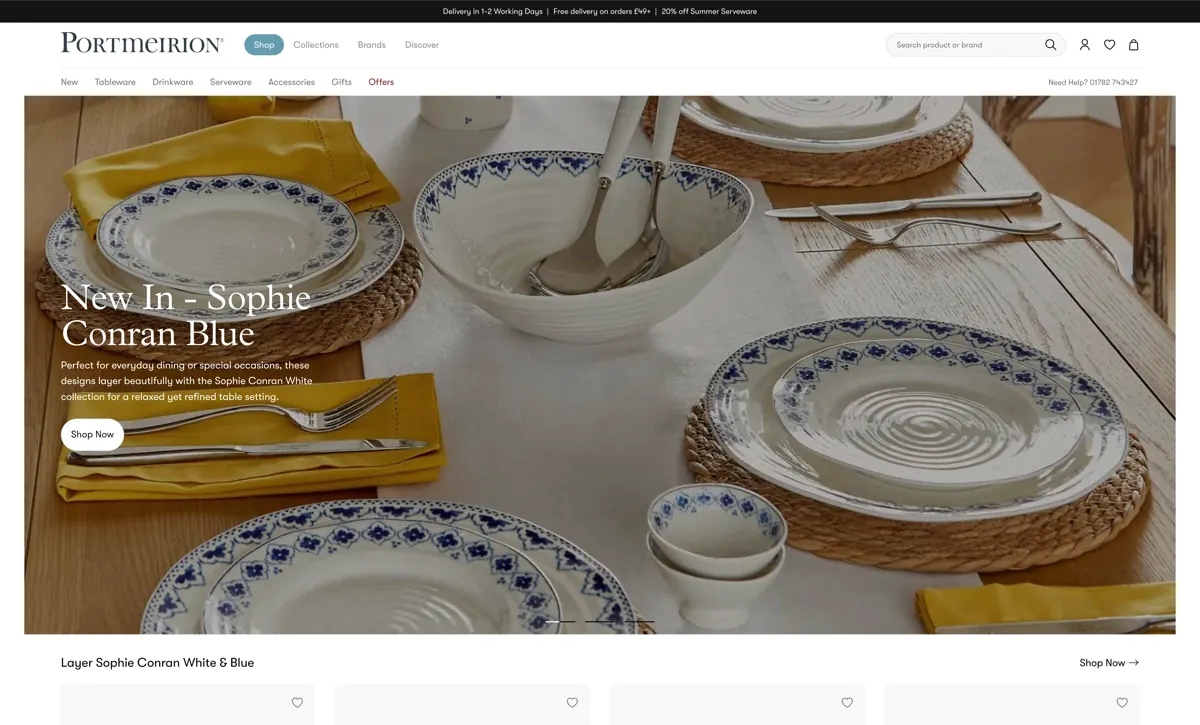
Portmeirion's Botanic Garden range has been in British kitchens since 1972; the company itself has traded since 1960. When a brand carries that much heritage, its online store has two jobs: sell, and do justice. Our engagement covered both sides of that equation — a full website redesign on Magento, and an AI-based inventory-prediction system working behind the scenes.

The Challenge: Heritage Brand, Modern Expectations
Portmeirion sells patterns, not products — customers collect a range for years and expect to find this season's additions alongside pieces they bought a decade ago. That collecting behaviour shapes everything:
- Collection-first navigation — shoppers browse Botanic Garden or Sophie Conran as a world, not a category of SKUs
- Deep, long-lived catalogue — ranges stay on sale for decades, so information architecture has to scale in time as well as size
- Seasonal demand spikes — Christmas ranges and promotions create brutal inventory swings for a manufacturer-retailer
What We Built
A Collection-Led Redesign on Hyvä
The storefront runs Magento 2 with a Hyvä front end — the Tailwind CSS and Alpine.js theme architecture that strips out Luma's legacy JavaScript. For a catalogue this image-heavy, the payload discipline matters: collection pages stay fast even with rich range photography, the core concern of our page speed optimisation work.


A Checkout That Matches the Brand
The checkout is fully branded and deliberately calm: a two-step Delivery → Confirm & Pay flow, local-pickup and home-delivery options side by side, and an order summary that keeps the basket visible throughout. No third-party checkout chrome breaking the spell at the moment of payment.

AI Inventory Prediction
The second half of the engagement never renders a pixel. We built an AI inventory-prediction system that learns from historical sales, seasonality and promotion calendars to forecast demand per product — flagging what will run out and what will overstock before either happens. For a business that manufactures its own ranges, that forecast feeds production planning, not just reordering.
This is where we see AI deliver real commerce ROI: not chatbots, but demand forecasting wired into the systems a merchandising team already uses. The forecast is a strong default a human can override — never an oracle.
It is a pattern we now repeat across our AI and ML development engagements, and the thinking behind it is laid out on our AI services page: start narrow, wire into existing workflows, measure against decisions a buyer actually makes.
The Technology Stack
- Magento 2 — deep, long-lived catalogue with complex set/range merchandising
- Hyvä theme — Tailwind + Alpine.js storefront; minimal JavaScript, image-first pages that stay fast
- Branded step checkout — custom two-step flow with pickup/delivery logic
- AI demand forecasting — per-SKU predictions from sales history, seasonality and promotions
In our experience, heritage retail brands get the most from this pairing: the storefront earns the customer's trust, and the forecasting quietly protects the two numbers that decide a retail year — availability and stock-holding cost.
Sitting on Sales History You Don't Use?
If your team still forecasts demand in a spreadsheet the Friday before a range launch, you already own the data to do better. Talk to our engineering team about what a redesign, a faster storefront or a working demand forecast would take — we reply within a business day with an honest read on scope and cost.